Local Theaters Usa Sections Plans Elevations Drawings
By Basile Baudez and Maureen Cassidy-Geiger
The post-obit text has been excerpted from Living with Compages equally Art, the recently published catalogue of Peter May's drove of drawings, models and architectural artefacts. The catalogue is edited past Maureen Cassidy-Geiger and published in two generously illustrated volumes. The first volume includes essays by Maureen Cassidy-Geiger, Basile Baudez, Charles Hind and Matthew Wells.
More information about the catalogue can be found here. A number of drawings from Peter May'due south collection are currently existence exhibited at the New York Historical Society.

THE BEAUX ARTS TRADITION
'Everything that is made or studied is competition, the educatee does non make a pencil stroke which is not the result of a competition.' [1]
The majority of the French architectural drawings in the Peter May collection are in the classical Beaux-Arts style that flourished in France for nearly 3 hundred years, from the institution of the Académie Royale d'Architecture in Paris in 1671 until the mid-twentieth century. [2] The architecture school merged with the Académie des Beaux-Arts in 1816, known from 1865 as the École des Beaux-Arts and from 1968 to the present day every bit the École nationale supérieure des Beaux-Arts (ENSBA). An emblem of the state, the French organization was modeled afterward the famous renaissance art schools of Florence and Rome, the Accademia del Disegno founded by Cosimo I de'Medici in 1563 and the Accademia di San Luca opened in 1577, which were enlightened alternatives to the onetime-fashioned guild system. [3] The École was initially located in the Palais du Louvre and moved to its present site in Saint-Germain-des-Prés in 1816, with an archway at xiv rue Bonaparte and a campus that runs forth Quai Malaquais (fig. iii). The main building was designed by Félix Duban (1798–1870) as an architectural model, backdrop and exhibit for fragments from the defunct Musée des Monuments Français also every bit a large instruction collection of plaster casts and building models (fig. ii). The renaissance portico of the ruined Château de Gaillon dominated the forecourt until 1977, when it was restored to its original position in Normandy (fig. 4).
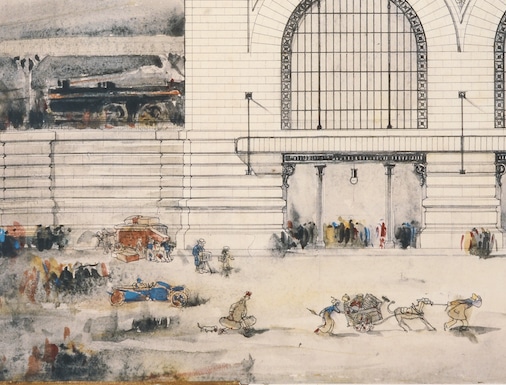
Beaux-Arts draughtsmanship is characterized by its lack of perspectival geometry. Thus, a building is rendered in orthogonal lines and any sense of volume is supplied by the strategic utilize of shadows. Sometimes broad gestural washes of color were added to the canvas, to situate a building in its imagined topography or urban environs, transforming the otherwise flat orthographic designs into m architectural paintings. The staffage might even extend to the inclusion of animating human figures, vehicles and animals, as in Bernard Tabuteau's (1892–1977) design for a railroad station, which was enlivened past a cast of colorful characters including a man rushing with his heavy baggage and a dachshund, a couple trying to persuade a donkey to pull their overloaded cart, a photographer plying his trade and a fancy blue sports motorcar (fig. 5).
Admission to the school was by recommendation of a sponsor until 1823, when entrance exams were introduced. Students attended lectures on mathematics, architectural theory, and construction in the academy building, studied and sketched the fragments and plaster casts and had access to the library. Practical architectural skills, however, were acquired outside the school in individual ateliers, run past leading practitioners, many with affiliations to the Academy. Gabriel Pierre Martin Dumont (1721–1791), for example, would teach paying students the principles of geometry and arithmetic, the right utilise and drawing of the 5
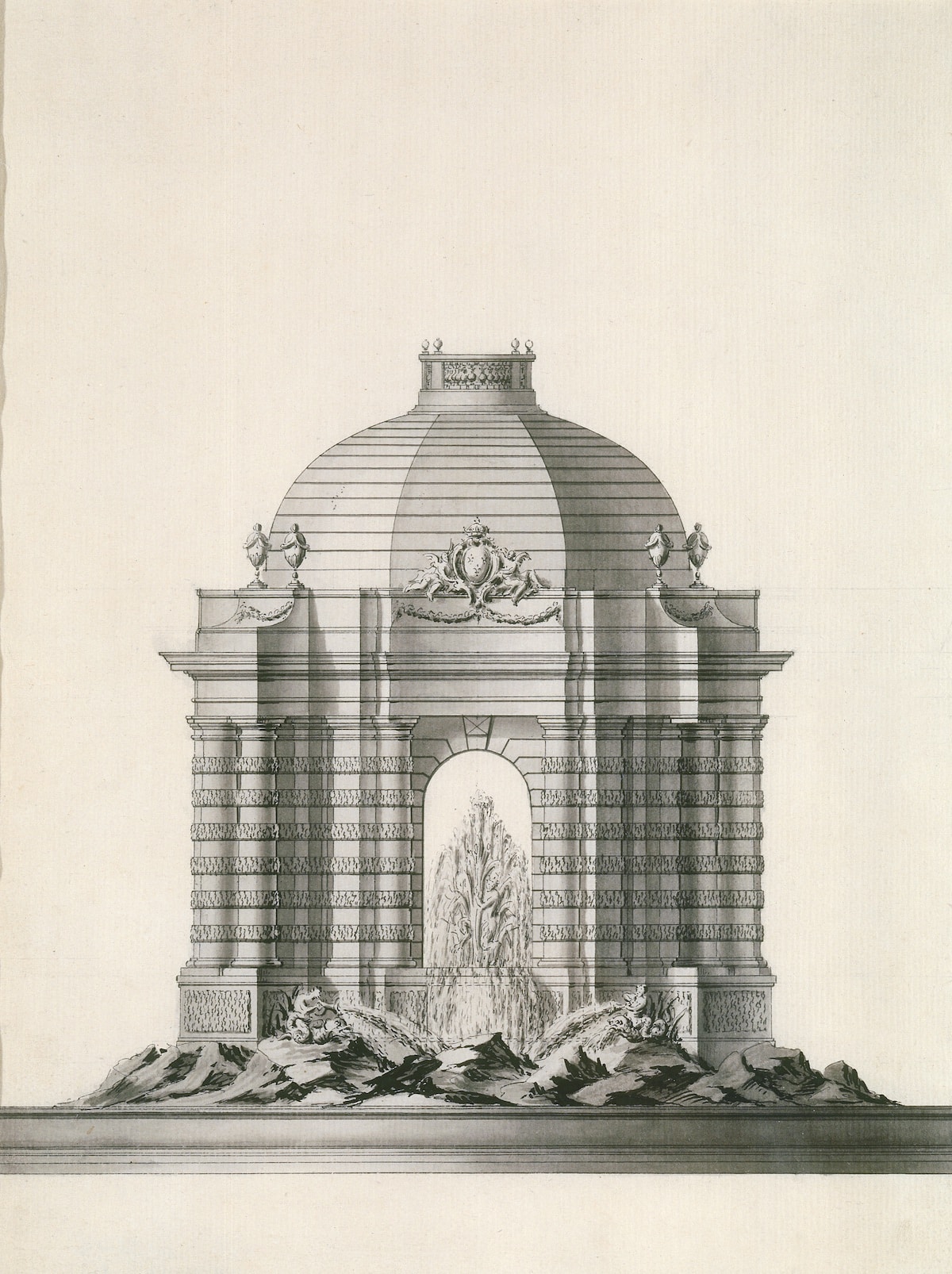
classical orders, perspective drawing and fifty-fifty such basic skills as working with inks, washes and watercolors. The more advanced students would and then practice selected unproblematic types of compages, perhaps besides copying drawings like the design (fig. 6) for a fountain past Dumont, which incorporates traditional elements borrowed from ancient and renaissance models and the architecture of the ancien régime. Atelier training prepared the logistes, equally they were known, for the regular drawing competitions, the concours, held at the Academy, past which students would advance at their own pace from the second or lower class to the showtime or upper class by accruing valeurs (points) awarded by a blind jury. The ultimate goal was to win enough points to qualify for the prestigious Prix de Rome, which provided the prize winner with a scholarship to the French Academy in Rome for three to five years. This rigid arrangement of education, consisting of atelier preparation and drawing competitions, with some supplementary lectures and coursework, formed the essence of architectural training in France until the 1960s. Students did not per se graduate from the École until 1867, when diplomas were finally introduced, and in 1943 the championship of builder was approved by law. Notwithstanding, the institution prepared students to enter the professional world and ensured those who had secured the Prix de Rome, or at to the lowest degree the diplôme, a successful career.
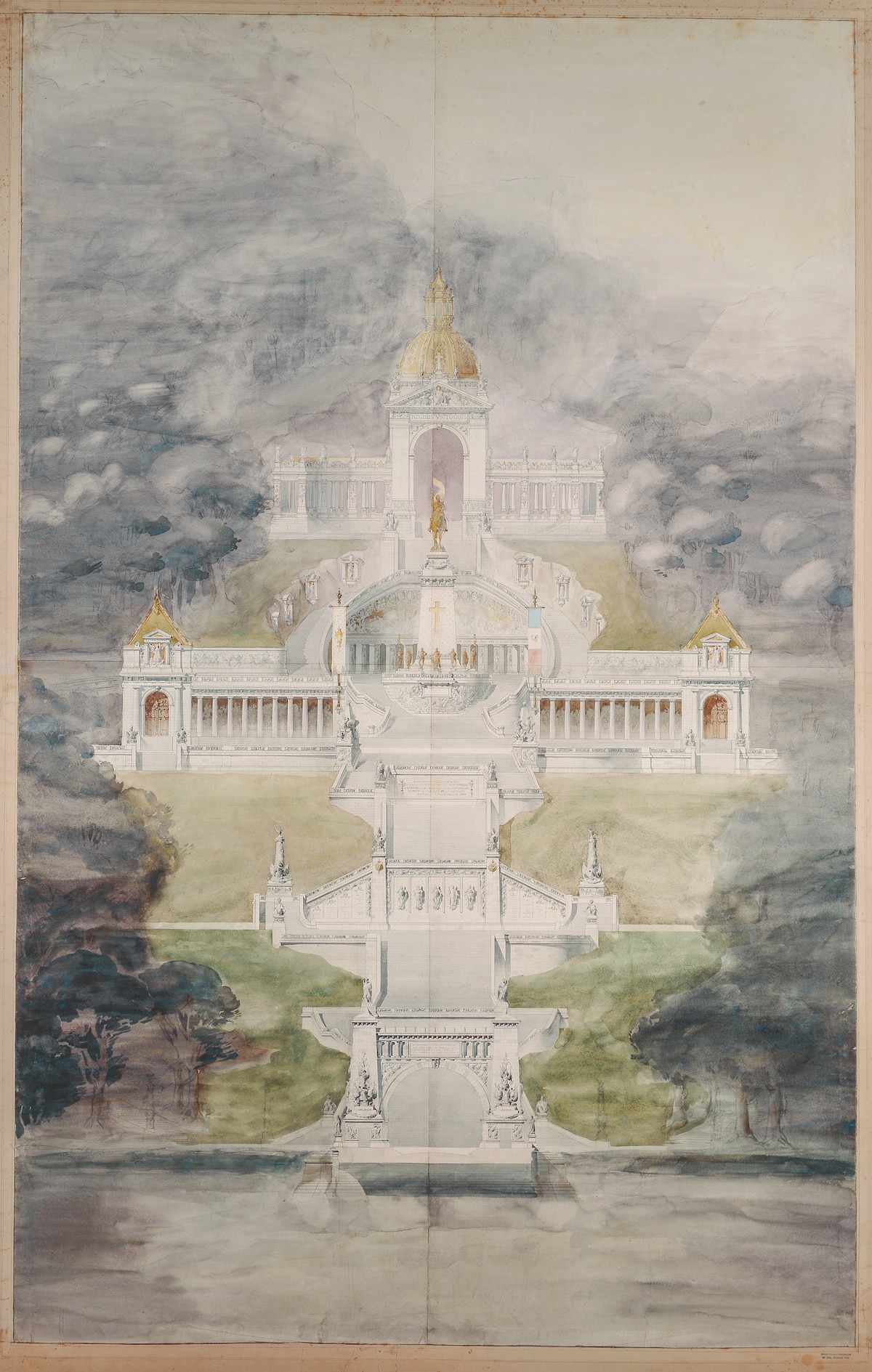
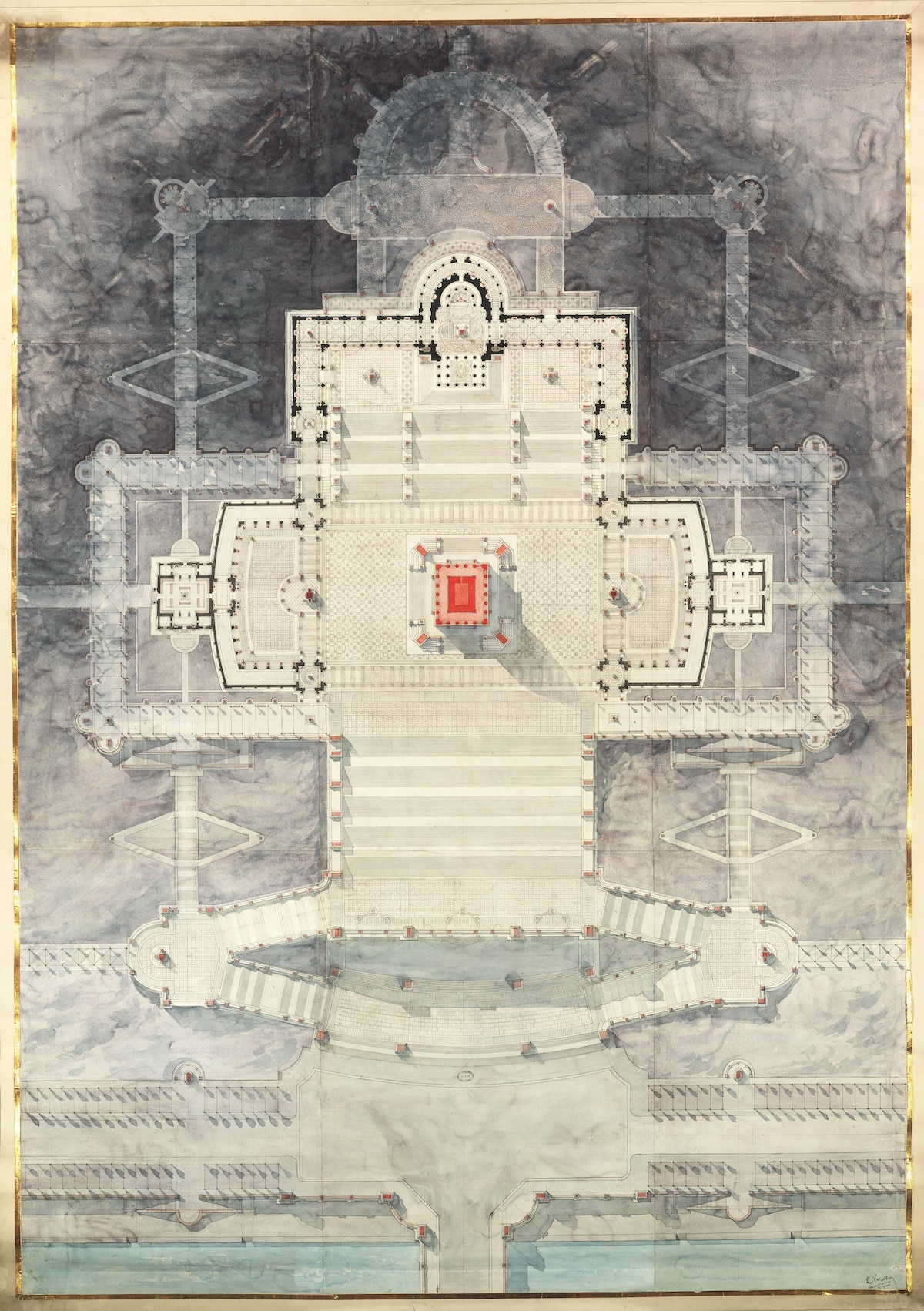
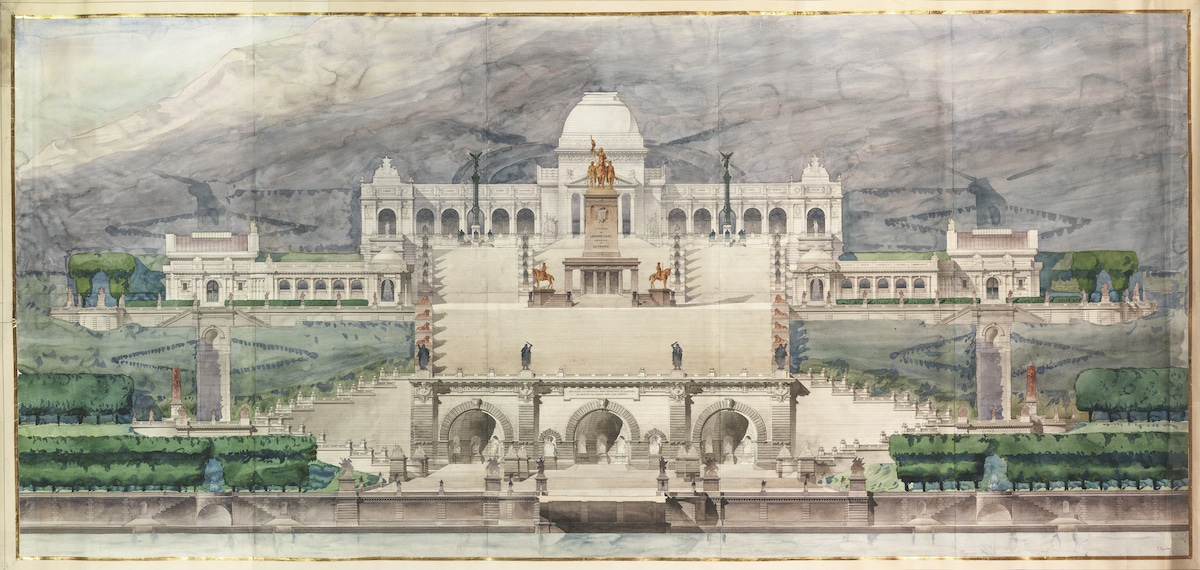
Two grandiose drawings past Georges Pradelle (1865–1934) in the May Collection exemplify Beaux-Arts draftsmanship and training (fig. 7). In 1890, after five years at the École des Beaux-Arts in the atelier of Julien Guadet, xx-v-year-former Pradelle was one of the eight contenders for the Prix de Rome. That twelvemonth, the professional jury overseeing the competition chose a 'Monument in honor of Joan of Arc' as the assignment. Jules Lenepveu (1819–1898), former Director of the French Academy in Rome, had just finished his cycle of paintings for the Panthéon in Paris on the life of the famous fourteenth-century martyr who would before long become the symbol of French patriotism following the disastrous conclusion of the Franco-Prussian War (1870–71). The educatee project was assigned in the form of a printed pamphlet which laid out the rules and formal instructions for the competition, including a short introduction, the building's requirements, dimensions, and site, and the number and scale of the drawings required. In this case, four large-format drawings were required: a plan, elevation, cross-section, and longitudinal section. When the contest was judged, Emmanuel Pontremoli (1865–1956) was awarded first prize, while second and third went to Louis Varcollier (1864–1948; figs. viii and 9) and Louis Sortais (1860–1911) and Pradelle took fourth place. Every bit was customary, the drawings were exhibited to the public for 3 days before judging and Pontremoli'south winning designs remained with the École des Beaux-Arts while Pradelle's were retained past the builder and at some betoken sold. [iv]
cat. 12.34).
The Ateliers
The ateliers were an eighteenth-century phenomenon that flourished in Paris every bit the profession gained legitimacy, and they quickly became integral to the existence of an architecture program at the École. They might prepare a pupil for admission or, more typically, for the concours. The patron, as the head of the workshop was known, would come into the atelier 2 or iii times a calendar week to tutor the logistes and critique their drawings. Jean Béraud (1882–1954) was enrolled in the atelier of Victor Laloux (1850–1937; fig. 12) and was jointly taught by Laloux's assistant and successor Charles Lemaresquier (1870–1972), and then he inscribed both names on the small-scale-calibration projects prepared in 1903 for admission to the École (fig. x and xi). According to an eyewitness, when Laroux critiqued the logistes, he was followed from table to tabular array, 'giving his judgement to each student in plow. Having made the rounds, he would bow, put on his silk hat and quietly leave the room, but no sooner was the door close than pandemonium would break loose and a noisy discussion of what he had said would ensue.' [five]
Exceptionally, on Béraud'due south cartoon of a roof topped by a bell-tower, we find Laloux's handwritten comments in cherry pencil, for example, 'ombre mauvaise' (poorly rendered shadow) and 'ces cartouches ne s'adaptent pas' (these cartouches don't work), when it was more than customary for the patron to evangelize such feedback verbally or on tracing newspaper (fig. eleven). Accordingly, the drawing was given a 'ten' for 10th identify.
Some young men bypassed the ateliers by working for an architectural firm for wages. It was probably in the office of Jules Stoecklin (1837–1919) and his son Henri (1872–1957) that the young Jean Valentin (1884– 1965) drew the facade of their famous Hôtel Gallia in Cannes, in the South of France (fig. 13). The Stoecklins established themselves in this resort metropolis of the Côte d'Azur in 1877, and rebuilt the Casino des Fleurs in 1888. In 1900 they were commissioned to design the Gallia, which served an international clientele. Before inbound the Stoecklin function, Jean Valentin most likely learned the basics of architectural drawing from his male parent, André-Jules Valentin (b. 1845–after 1906), a successful provincial practitioner who made his entire career in Avignon. [six] It is possible the young Valentin found in the Stoecklin father-and-son team an repeat of his own family practise, leading him to sign his cartoon of the hotel 'Jehan Valentin' plus 'Jehan Valentin fils,' 'Jehan' a rendering of 'Jean' in Quondam French. Valentin later enrolled in the national architectural school in Marseilles, one of a handful of regional schools established by the government nether the authority of the École des Beaux-Arts of Paris, which judged all regional competitions. Amid the offshoots were schools in Rouen, Rennes, Lille and Lyon.
The Concours and the Prix de Rome
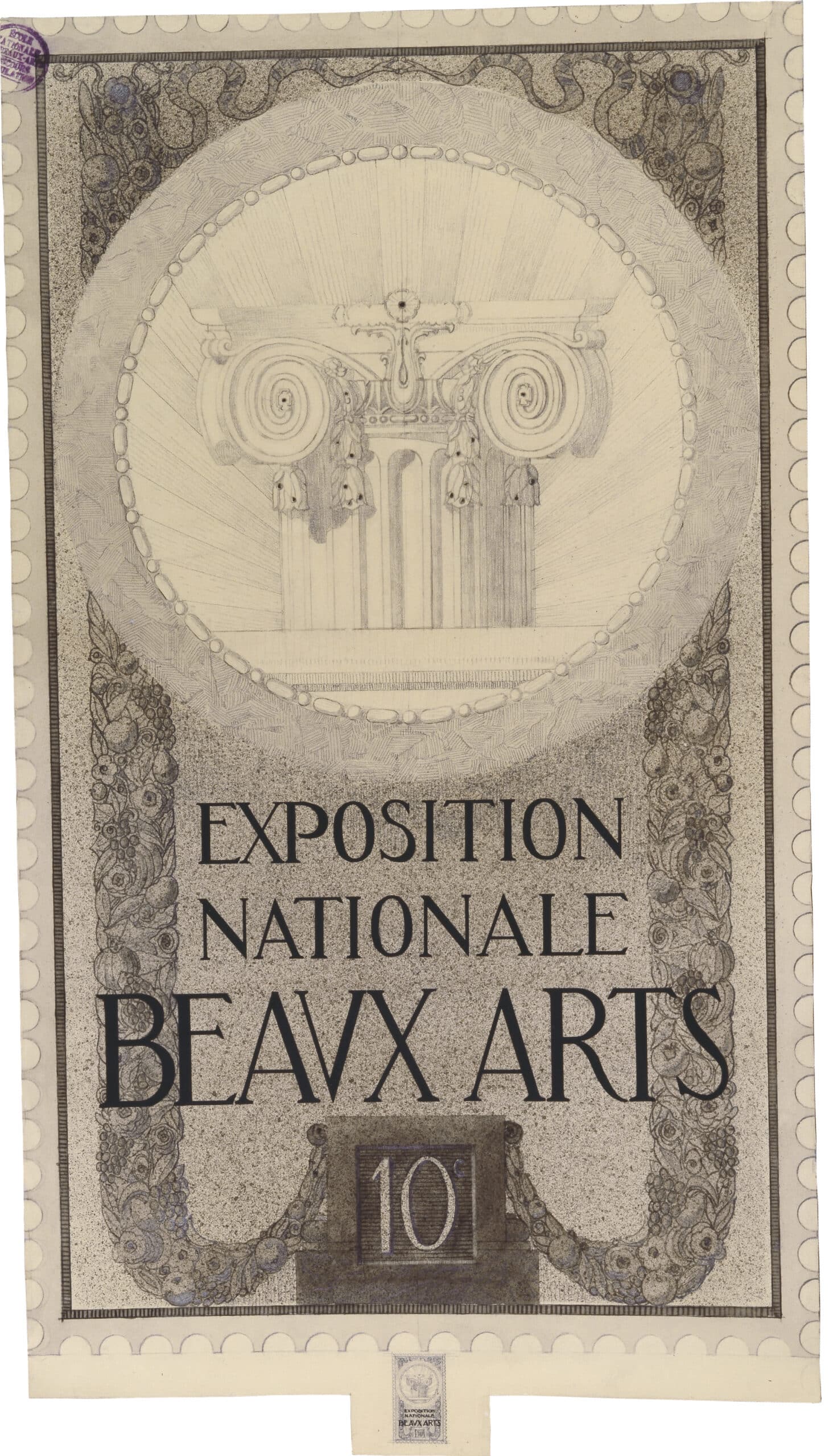
Students at the Academy progressed from the second level to the first level, and from the first level to the Prix de Rome competition, by winning points in the concours. Twelve-hour concours d'essai or esquisse (sketching competitions) alternated with more challenging multi-week concours rendus (rendering projects); at least two concours were required of the students annually. The subjects of the assignments were determined past an bookish committee and many were repeated over fourth dimension or new building types emerged. Some assignments even moved beyond the realm of architecture, extending to poster and stamp designs (figs. 14 and xv). Notations added later in pencil, ink, or crayon might give the name of the author, atelier, date and award; some drawings are also stamped with the seal of the school (see figs. 16–17). Valeurs were accrued for winning a kickoff- or second-place mention (award). In 1819, six valeurs were required to accelerate from the 2d to the kickoff level; by the stop of the century, 20-one points were needed.
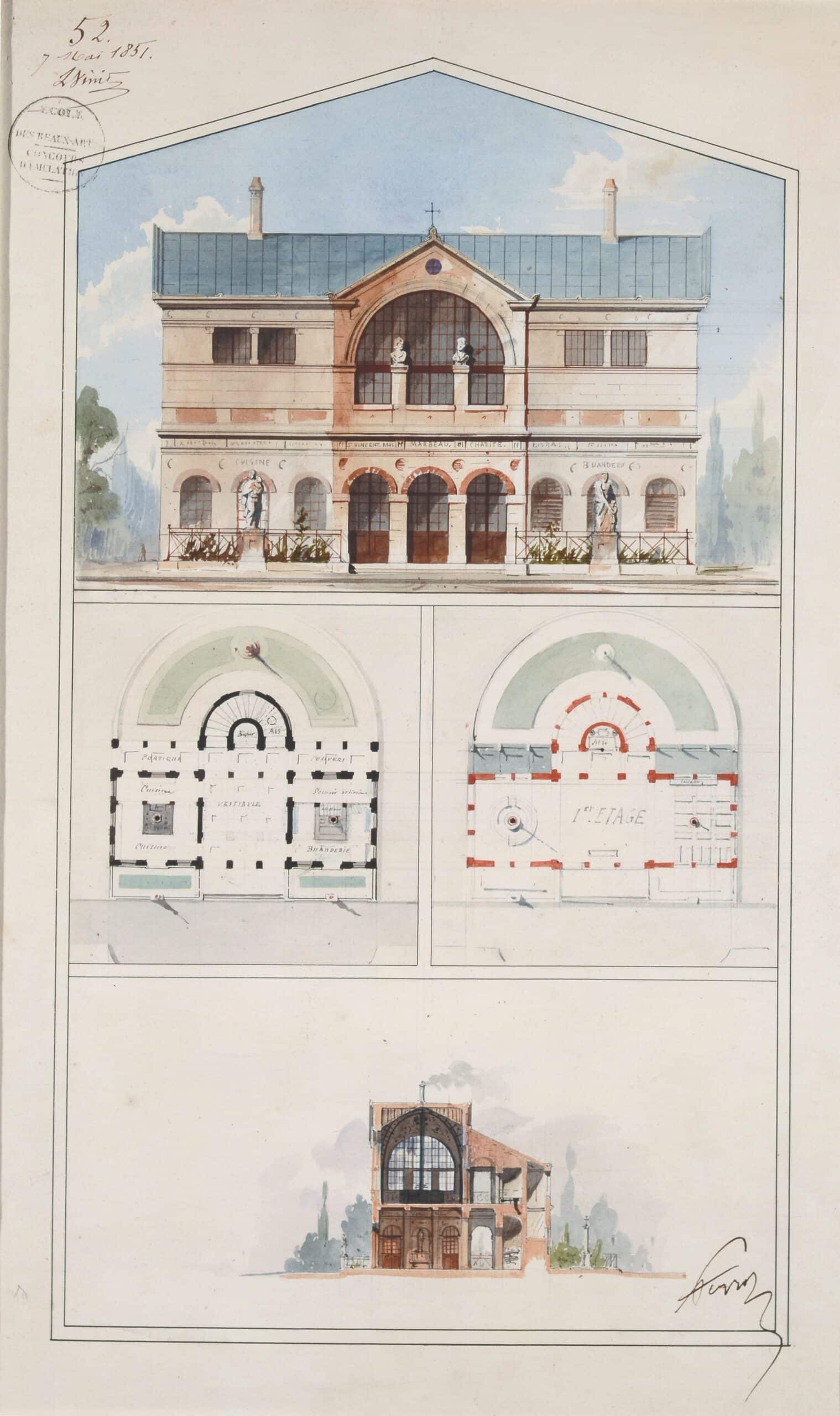
The concours d'esquisse comprised an meridian, cantankerous-section and 1 or more plans for a small-scale building composed on a single canvas of paper in pencil, ink and watercolor. The garden kiosk designed in September 1846 by 2d-level pupil Louis-Alfred Perrot (1828–1870) is an example of this type yet shows him struggling every bit much with his pencil and as with his paintbrush (fig. 16). Just a few years later, Perrot had made spectacular progress in drawing and painting, as demonstrated by his designs for a morgue of 1848 and for a hospital of 1851 (true cat. 3.17, and see fig. 17). Arched compositions came into vogue as the century progressed and monochrome drawings in gray or sepia wash supplanted the use of watercolors, every bit in the designs for 'Un Campanile ou Tour pour les cloches' (Bell-tower or clock-tower) dated March ii, 1881, which received a second-place mention (fig. xviii). The handwritten assignment for the showtime level project specified:
This tower, which would be the complement of a parochial church of the beginning order, would be independent and placed either in front of the church building, or backside it, or to the side, like the campanile of Santa Maria dei Fiori in Florence.
It will include, in its lower office, a room for the ropes for pocket-sized bells, and i or more sets of stairs. In its upper part, there volition be one or two floors for big and modest bells. Ane or more clock dials volition be placed on the facades.
The height of the campanile will be fifty meters; its style should exist in harmony with that of the church, which is from the Renaissance period. The programme of the lower floor and the plan of the upper floor should be executed to the scale of 0.0025 to ane meter and the top double that.
Paris, 2 March 1881
Lesueur. [seven] (fig. xix)
Drawings that did not encounter the formal requirements were rejected. Autonomously from the traditional concours, students were as well tested in mathematics and perspective cartoon.
The field for the almanac Prix de Rome competition was reduced from 30 aspirants to eight on the ground of a twelve-60 minutes concours d'esquisse. The viii winners were then assigned a two-part concours rendus. Outset, the logiste executed a preliminary rendering of the assigned subject field in strict privacy, en loge (in their room). Next, he prepared an summit, cross-section, programme, and alternate view of his initial blueprint on big pieces of paper of an assigned dimension and scale. Between 1701 and 1966, the Prix de Rome subjects ranged from palaces, cathedrals, hospitals, spas, and schools to triumphal arches, theaters, hotels, government and commercial buildings, and museums. Students were immune several weeks for the rendus, working at first en loge and afterwards in the atelier, where they received communication from the patron and assistance from the other students. Sometimes a more gifted associate would be enlisted to apply the shadows or watercolor while younger students would gear up the sail and paper on to which the large sheets of newspaper were glued for brandish. Some designs
were edged with paw-drawn borders or metallic tape. For transparency in the judging of the submissions, none of the drawings were signed; rather they were assigned a letter of the alphabet before being exhibited in the Salle de Melpoméne in the École (fig. 20). The public and press had access
to the exhibition for iii days before the jury met to deliberate. The winner was entitled to a iii- to v-year fellowship at the French University in Rome, where he would study antique ruins and the architectural creations of the Eternal Urban center and beyond (fig. 21).
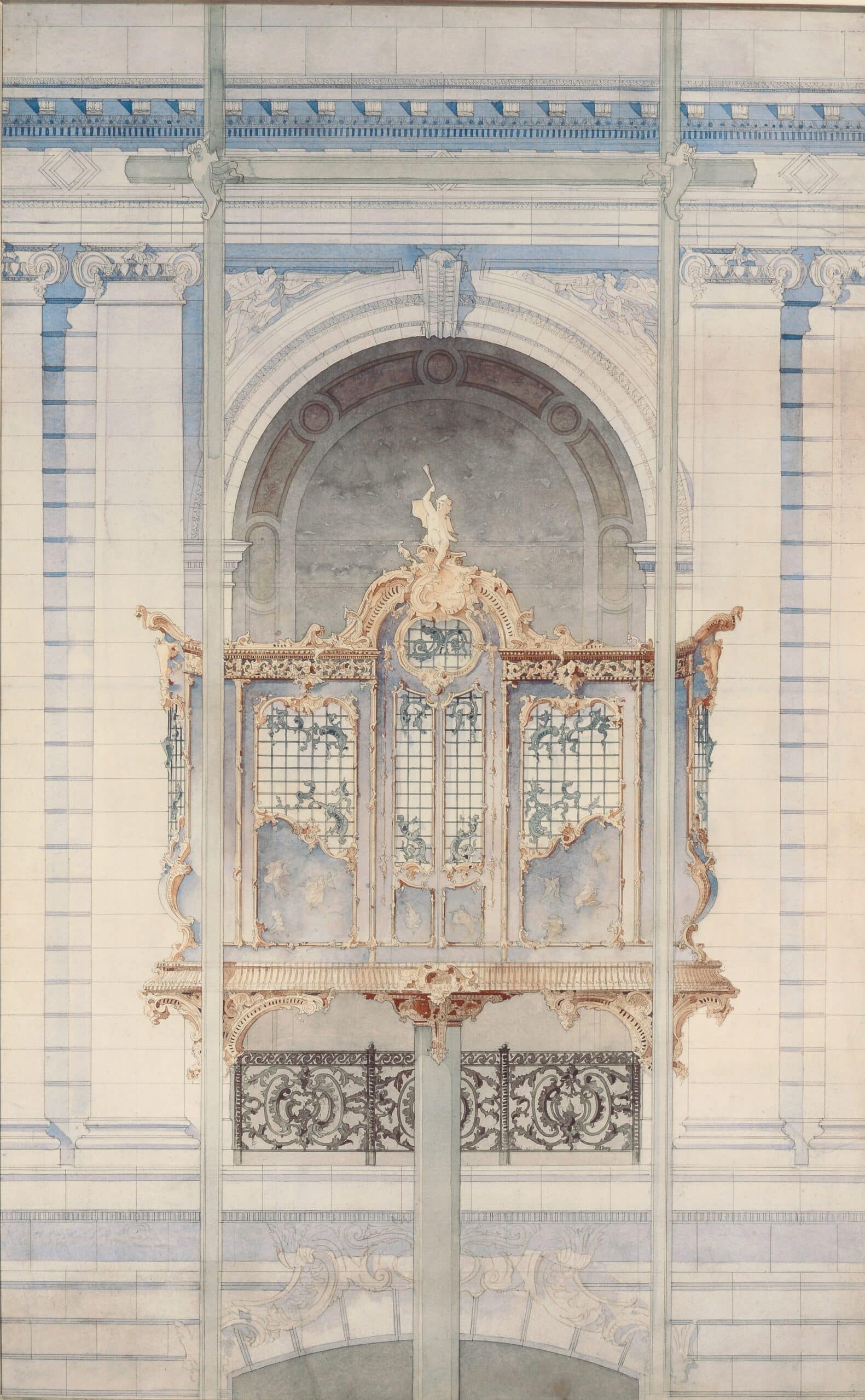
In the nineteenth century, further cash prizes were introduced, such as the Rougevin, Godeboeuf, Chaudesaignes and Duc prizes, the terminal won by Émile Camut (1849–1905) in 1893 for his hitting designs (fig. 22) for the Mont-Dore spa in the Auvergne region of French republic. Some of these competitions involved the study of a particular chemical element of decoration or construction, for example a retardataire Chambre d'Apparat (state chamber) (fig. 24). The 1890 Godeboeuf competition was for an elegant yet modernistic hydraulic elevator motel in the rococo-revival sense of taste (fig. 23):
Metal decoration of the cabin of an elevator.
Assumed to be in a rich traveler'southward hotel, a large elevator connects the floors in a glassed courtyard serving as a central hall. The motel is visible throughout its route and must be elegantly busy. On a frame of iron and wood in that location is fine relief in copper; information technology is therefore in the use of metallic thus worked that the ingenuity of the elements and artistry volition be observed. The metallic can exist gilded, silvered and even enamelled in some parts. Weather to observe: the distance betwixt the vertical runners will exist exactly three meters. In that location will be no ceiling; the walls will nowhere be less than 2 meters high and may include openwork, without, however, any possibility of reaching hands through. There will be a door with ii small panels. The maneuvering weather of this elevator permit moreover blithe silhouettes. Elevators take so far been treated just from a commonsensical point of view; there is no dubiety, still, that at that place is here an occasion for designing an elegant and graceful composition and an attractive plan for artists. For the sketch the facade is required on the side of the door at 0.04 to 1 meter and the plan at 0.02 to 1 m. For the rendering, a programme to 0.05 to one one thousand, the same façade to the tenth and a particular of i's choosing at the quarter of the execution. The sketches will be drawn in pen and ink, any sketch which does non conform will be struck from the competition. [eight]
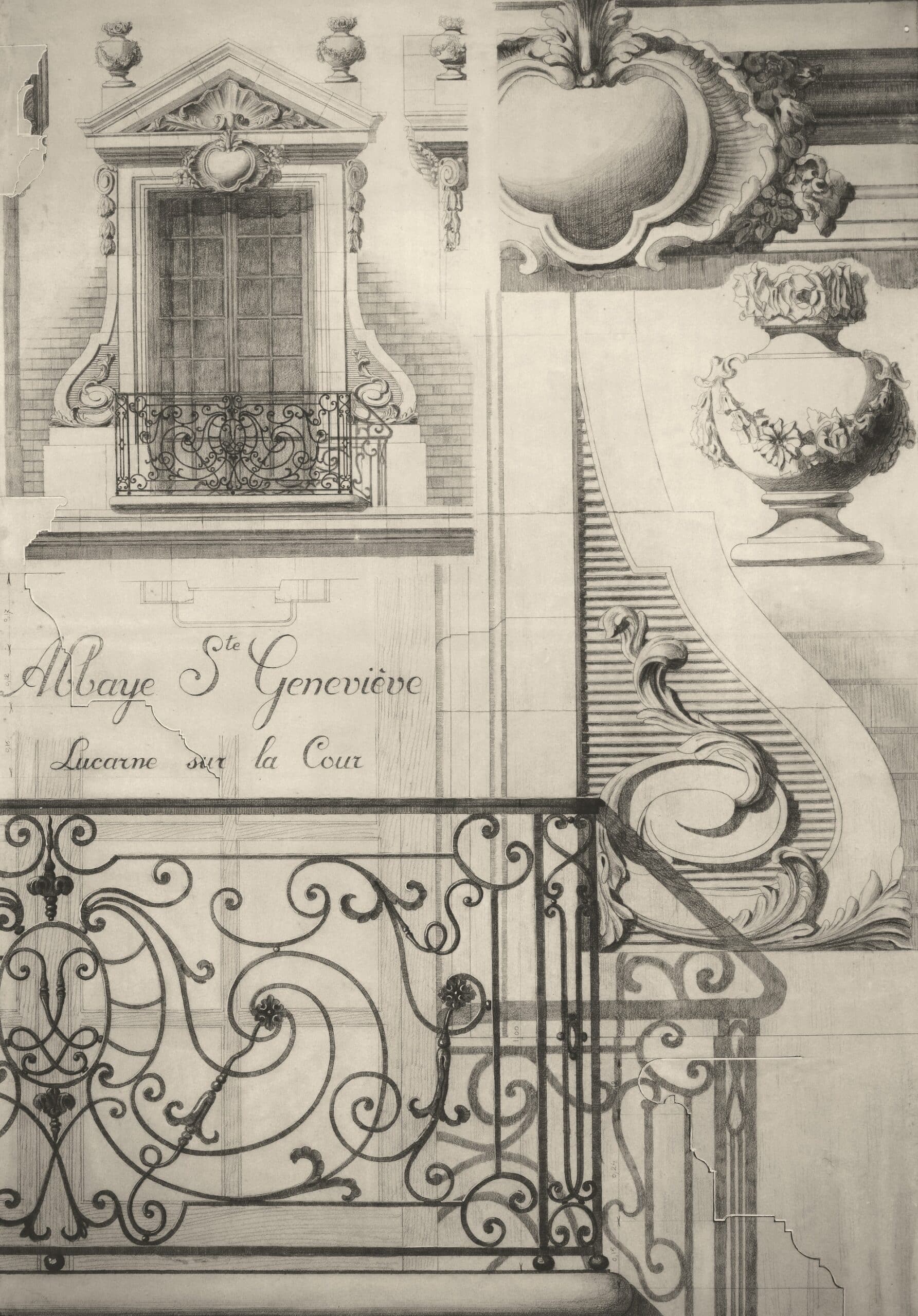
Analytical drawings were also assigned which required students to create an architectural still life composed of differently scaled fragments from local buildings. A masterful rendering of one of the dormers of the Abbey of Saint-Geneviéve in Paris, for case, shows a total peak in the upper left with a section on the left border, a plan below and a lateral elevation on the correct (fig. 25). These are flanked by large-scale drawings of the decorative elements: the railing, cartouche, vase, and volute. Further, the railing is shown in profile at the lower right and its shadow is projected on to the volute.
Construction drawings for masonry, carpentry, and cast ironwork, akin to structural drawings provided to builders, were assigned from the nineteenth century onwards, leading up to the annual general construction competition. [ix] A set of highly detailed designs for the Banque de France competition in 1909 betoken the structure of the foundations and footings, basement and roof. Further, the building materials were color-coded: crimson and pink wash for the rubble and brickwork, blue ink for the structural ironwork, black ink for the ornamental metalwork and brown launder for the woodwork (fig. 26). Furniture and lighting was indicated as well every bit the floor and, on the plans, arrows indicate the management of the stairs.
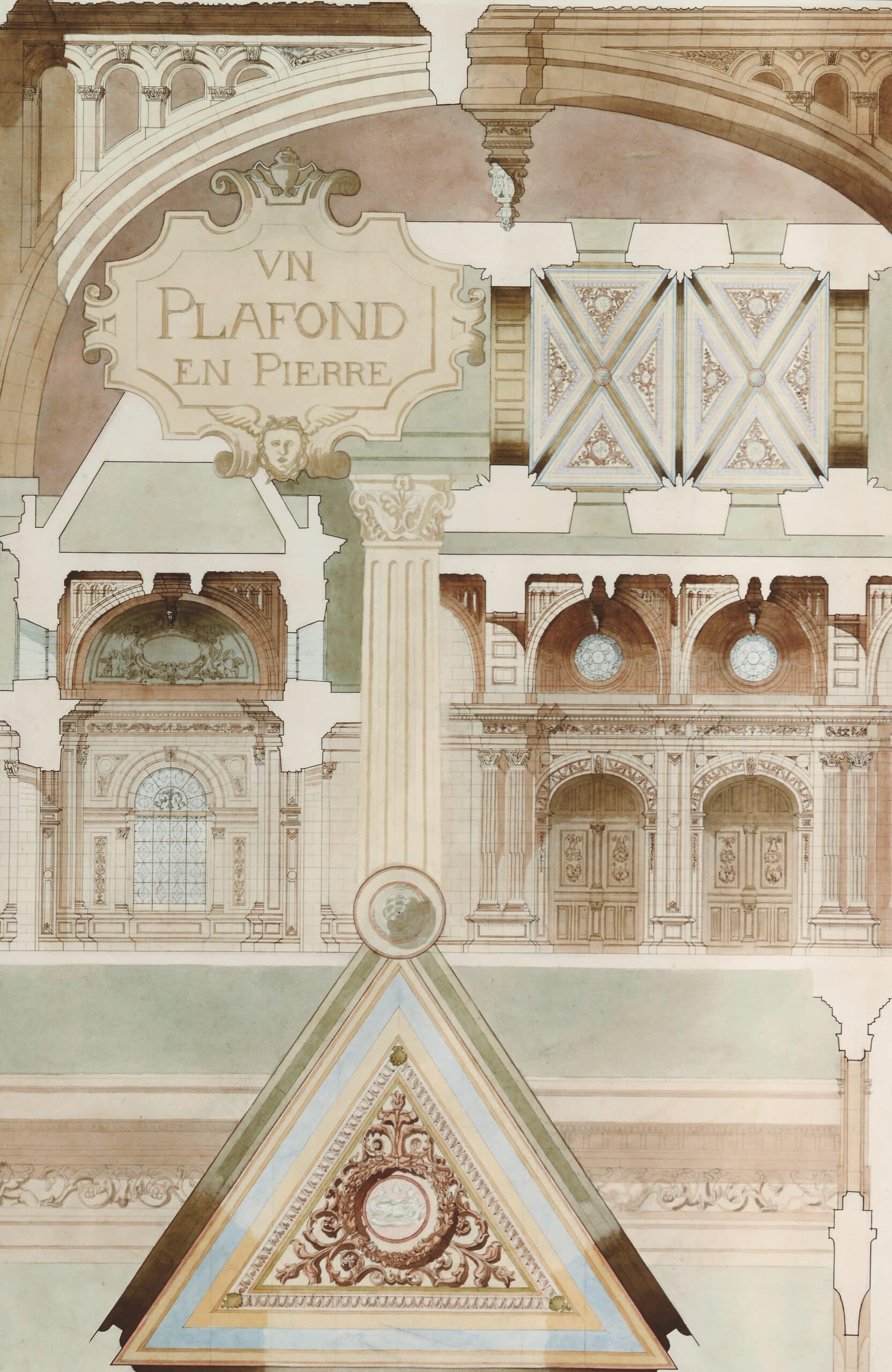
A pair of designs for a hotel even indicate the artwork, wallpaper and the mattresses and pillows on the beds (fig. 27). Construction drawings of great complication were as well assigned, such as the stonework ceiling assigned in 1901 and again in 1907 (fig. 28). Beyond titles and units of measure, texts characteristically were kept to a minimum and the inclusion of a legend was rare.
The Diplôme
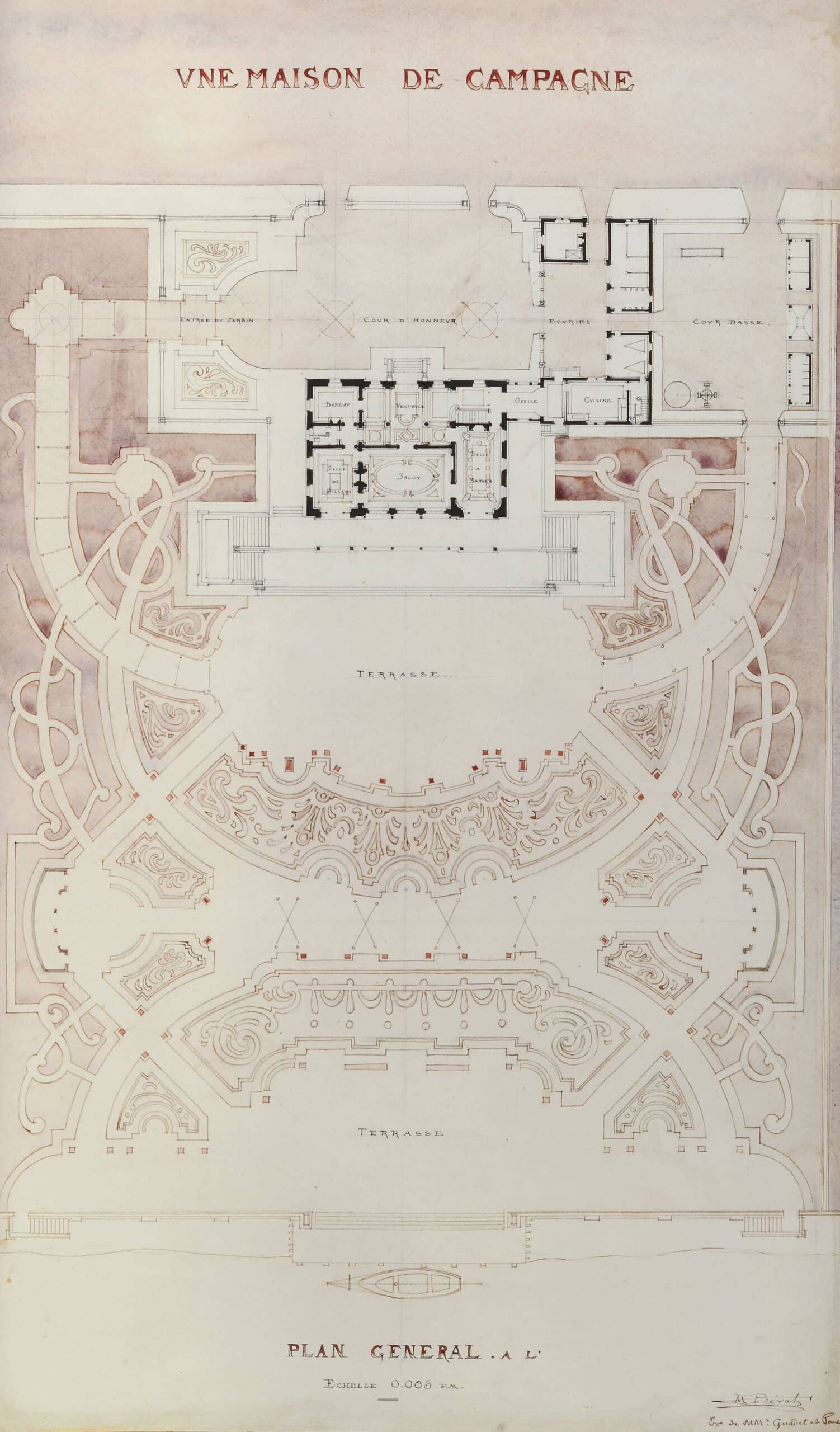
The diplôme was non instituted until 1867. Students with nine valeurs (points) and six projets rendus were eligible for this distinction upon completion of an oral test and a drawing assignment for a realistic building projection every bit opposed to the grandiose Prix de Rome programs. Hence, Jacques-Maurice Prévot (1874–1950) received his diploma for the country house he designed in 1900 (figs. 29–31). Prévot'due south early on professional person biography was typical of École students at the terminate of the century. was typical of École students at the stop of the century. Born in Bordeaux, he first trained with his father, an architect for the Compagnie des Chemins de fer du Sud de la France (Railway Company of the Southward), and uncle, a successful architect with a big private do in Aquitaine. In May 1893, Prévot entered the atelier of Julien Guadet (1834–1908) and was admitted to the École three months later. In March 1897 he advanced from the entry level to the first and received his diploma on June 22, 1900 with the country house project. Prévot's diplôme drawings include elevations of the front facade (fig. 29), of the garden facade and of one of the sides; an estate plan with the grounds (fig. thirty); plans of the basement, ground flooring, the second and tertiary flooring; transversal and lateral sections (fig. 31); the assignment too included plans of the carpentry work with details of the beams, articulation system, and flooring with construction details. When the Prévot drawings were acquired by Peter May they were plant to include others for the masonry and joinery of a country house by Jean Hébrard (1878–1960) and Pierre Ferret (1877–1949), who received his diploma in the aforementioned yr with the same country house program. These orphaned sheets notwithstanding can be seen to correspond lost sheets by Prévot for his project (fig. 32).
Prévot tried unsuccessfully to win the Prix de Rome earlier being hired by Cornell University in 1905. Every bit the Annual Report of the President of Cornell University for 1905 states:
Monsieur Prévot arrived in September from Paris, where he had made a brilliant career at the École des Beaux Arts, to assume the duties of the professorship of design, for which he had been recommended past the ever helpful friend and erstwhile Director of the College, Professor Alexander Buel Trowbridge. At his coming, Professor Prévot knew piffling English language, but his talent as an artist, his skill equally a instructor, and the amuse of his personal and social characteristics soon won for him the hearts and minds of the students and rendered him a universally welcome member of the University community. [10]
Trowbridge (1868–1950), who graduated from Cornell in compages in 1890, had been at the École des Beaux-Arts in 1893–95, where he befriended Prévot. The reputation of the École was sufficient to hire the Frenchman despite his lack of English. Prévot stayed at Cornell for 4 years before moving to New York, where he practiced in the office of McKim, Meade and White and on his own earlier returning to French republic probably after the First Earth War.
Envois de Rome
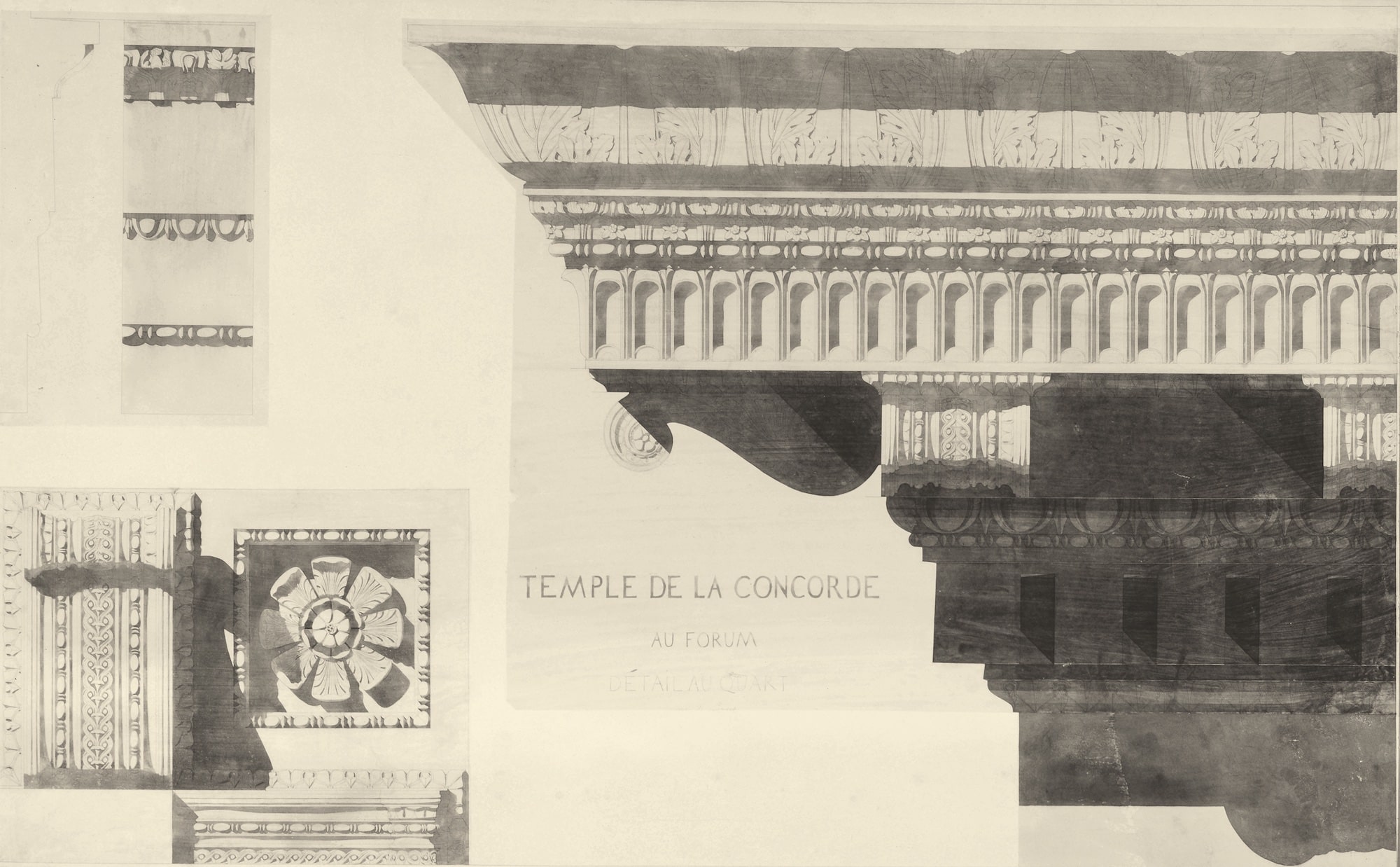
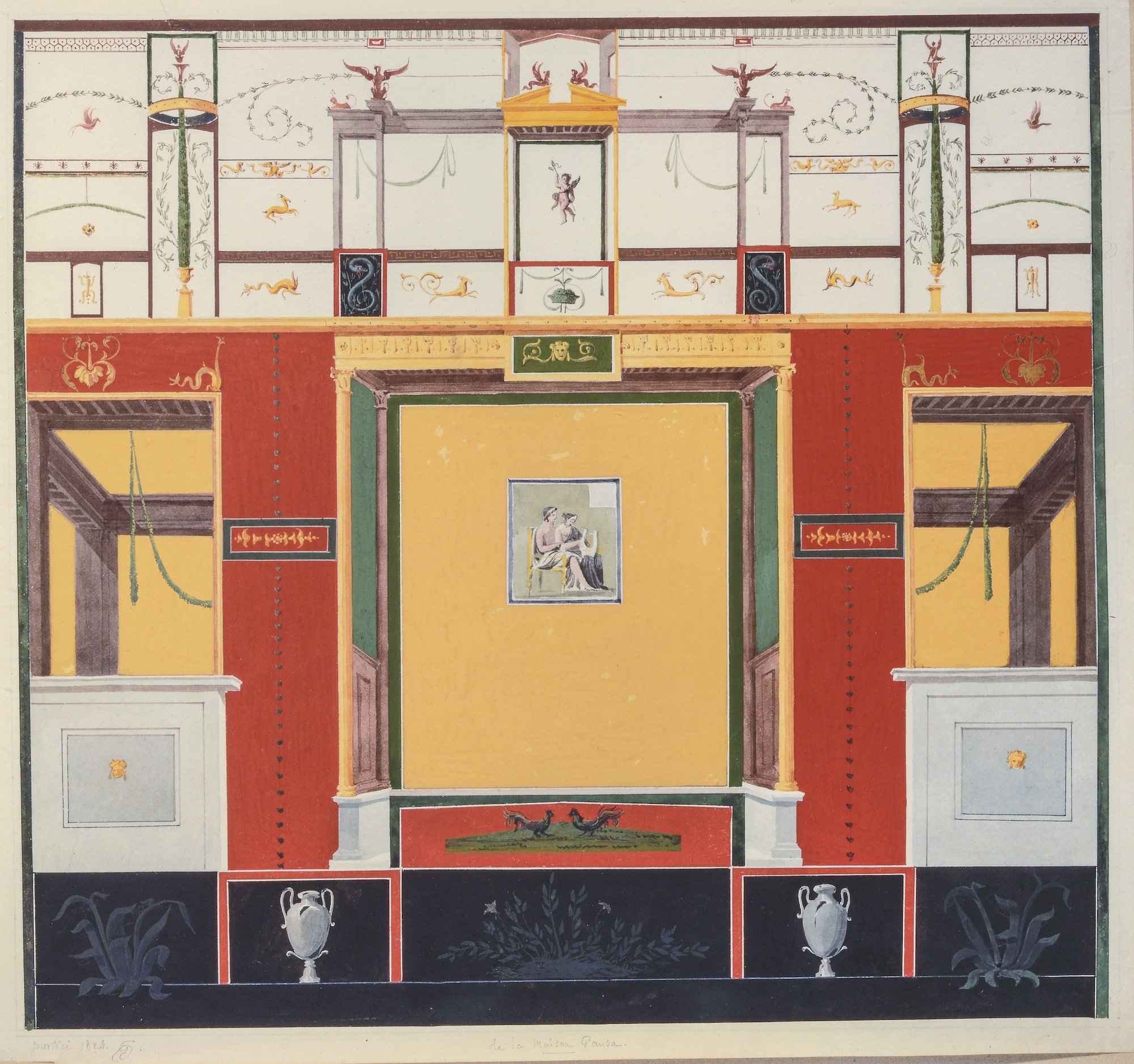
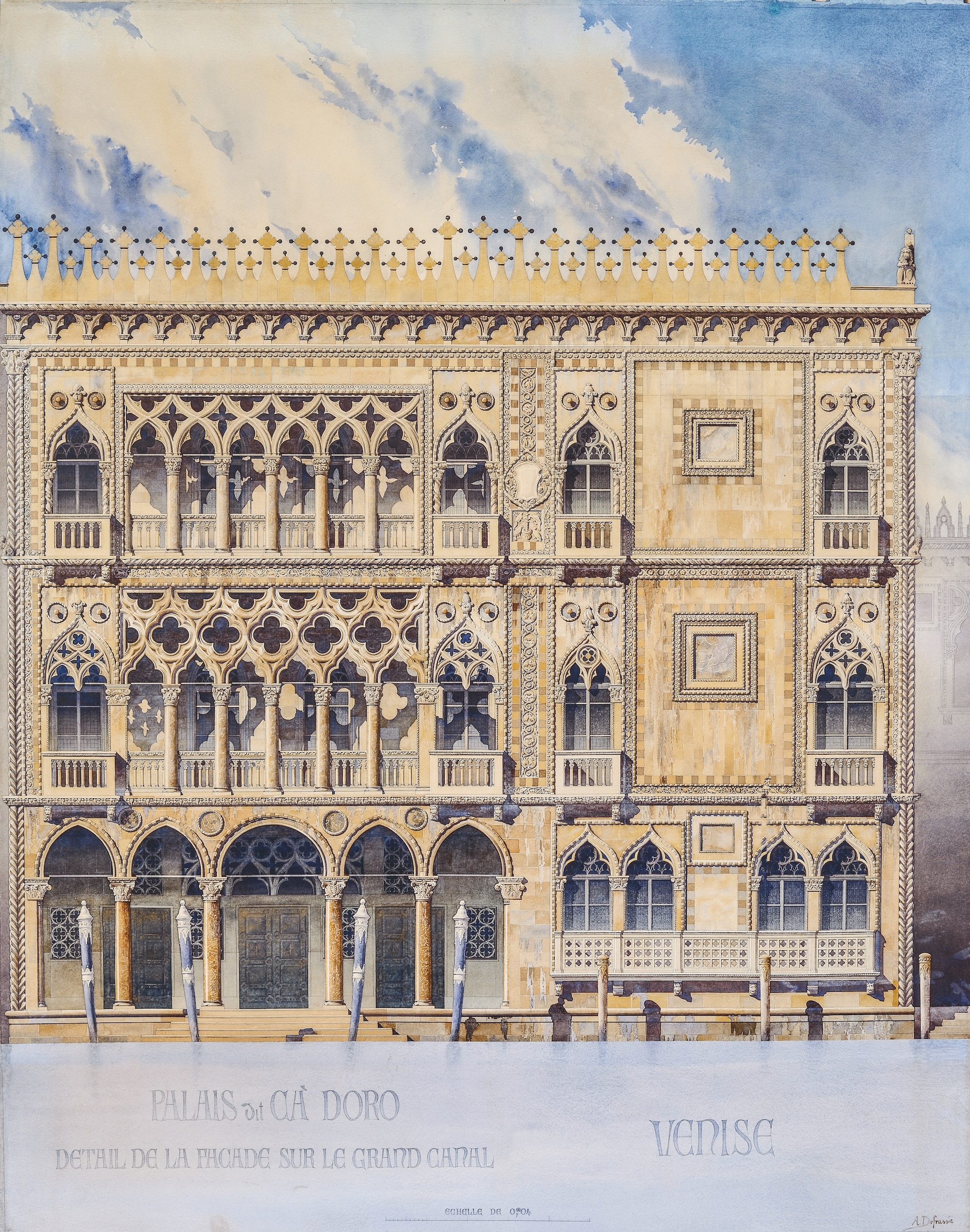
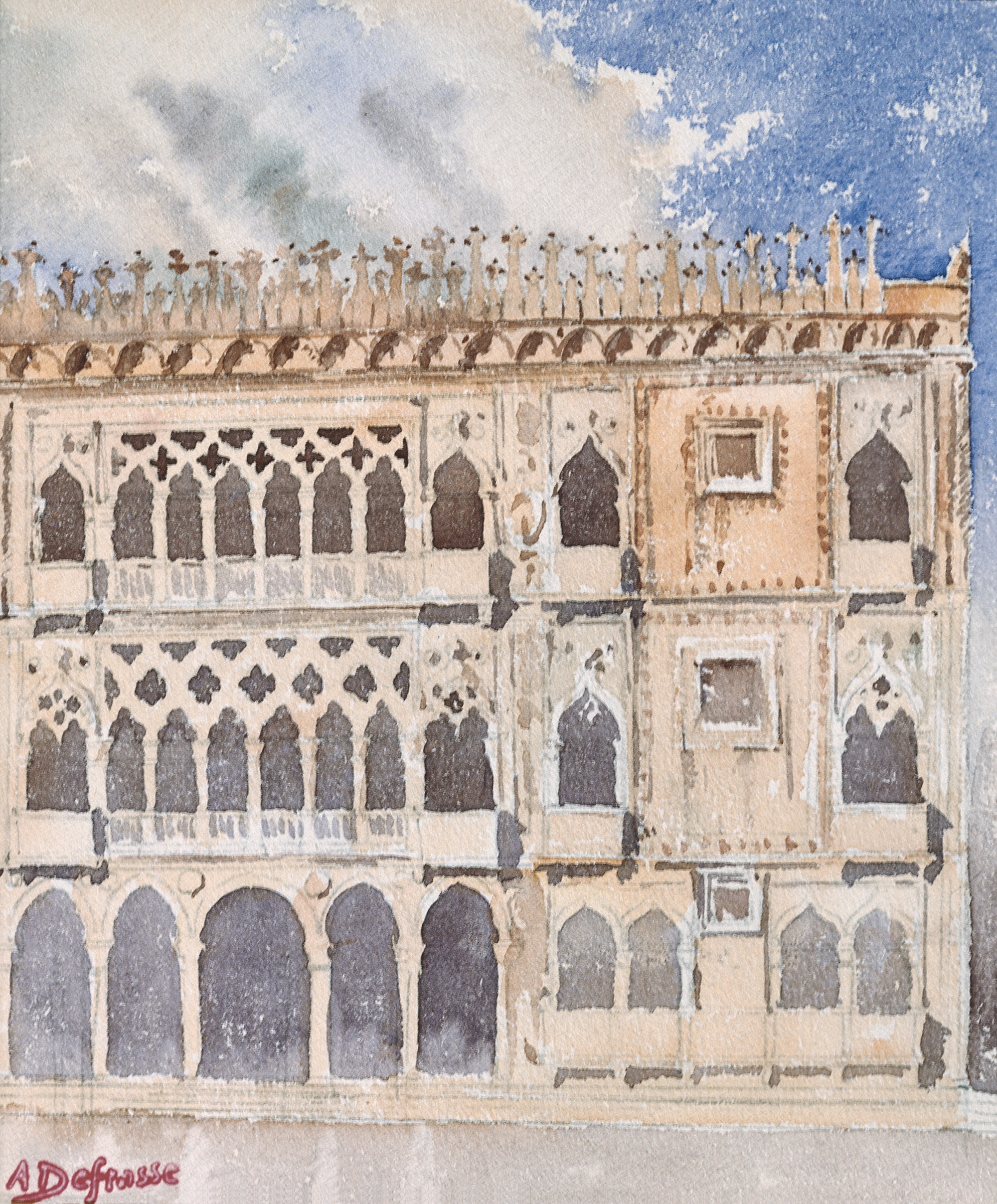
Envois de Rome were drawings sent to Paris annually by Prix de Rome winners to demonstrate their evolving cognition and understanding of ancient architecture abroad. Auguste Ancelet (1829–1895), for example, sent studies of the Temple of Concordia and of Jupiter Stator in the Roman Forum to the Academy in 1853 during his 2d year in Rome (fig. 33). By the fourth year, pensionnaires were asked for drawings of an ancient monument of their choice, surveyed and drawn in person, in its present condition together with a reconstruction drawing accomplished through careful study of the history of the building. [11] The remarkable frescoes excavated at Pompeii and Herculaneum apparently fascinated the pensionnaires, who rendered them in watercolor and gouache every bit if restored. [12] V sheets from an album by Émile-Jacques Gilbert (1793–1874) in the May Collection include a study of a wall painting in the House of Pansa at Pompeii (fig. 34). Students also took advantage of their fourth dimension in Italy to study other types of architecture beyond Rome. Alphonse Defrasse (1860–1939), for example went, to Venice in 1891 and made beautiful renderings of local landmarks. A small-scale watercolor of the historic facade of the Ca d'Oro was the basis for a large-scale restoration cartoon exhibited at the Salon of 1900, for which he received a golden medal (figs. 35 and 36). Though the École retained some of the envois for their athenaeum, a resource which survives and is accessible today to students and researchers, students generally kept most of their foreign studies, and sometimes exhibited them at the Salon in Paris upon their render.
[…]
The Beaux-Arts Tradition Beyond Paris
The reputation of the École des Beaux-Arts extended well across the boundaries of French republic and Europe and, by the tardily nineteenth century, architectural students from countries that lacked a tradition of formalized training were making their way to Paris. [xiii] Richard Morris Hunt (1827–1895) was the commencement American to be admitted to the École, in 1846, and thereafter until the Kickoff Earth War American students comprised ten to twenty per cent of incoming students. [14] Also, the commencement architectural departments in the United States modelled their curricula on that of the École, with a competition-based education, the two-step design procedure of the esquisse and the rendu, and the implementation of the manner and drawing conventions of the Paris school. The primeval design program was established at the Massachusetts Institute of Technology in 1868 by William Robert Ware (1832–1915), who had been trained by Chase. [fifteen] Students in MIT'south department of architecture followed a curriculum defined by Prix de Rome winner Abiding-Désiré Despradelles (1862–1912), who would teach at that place from 1893 until his death. Bostonian Leon Keach (1893–1991) entered the program in 1913 and avant-garde quickly, winning awards for drawings that were then published in the volumes of the Engineering science Architectural Tape. [16] In 1918 he won the silver medal for a prize from the Société des Architectes Diplômés par le Gouvernement Français, the professional person society of École architects founded in 1877. [17] Ten Keach drawings in the May Drove aptly represent the classicizing tendencies and creative conventions of the École tradition as taught and practiced in America. Get-go he learned to return simple elements like classical orders, mastering shadows and washes, and receiving a first mention for his 'Doric Capital from the Parthenon' (fig. 43). Next came a series of analytical studies for minor buildings, such every bit a sketch for a Club Firm dated November ten, 1915, which presented an height, floor plans, and a longitudinal cantankerous-department all on one sail of paper with muted staffage and the night poché indicating load-bearing walls (cat. i.37). In 1916, when a restaurant was the assigned building type, Keach drew inspiration from the Villa Medici in Rome, habitation to the French Academy, mimicking its iconic garden facade (fig. 44).
The Beaux-Arts program served not only as an educational model but also as a compelling architectural mode for burgeoning cities around the world. This is evinced by Camille Gardelle's (1866–1947) sophisticated designs for clients in Montevideo, the capital of Uruguay. Gardelle was the son of the urban center architect of Montauban, in the south of French republic, and entered the École in 1887, aiming without success for the Prix de Rome in 1894. After working for individual clients in and around Paris, he decided to emigrate to Montevideo in 1910. In that location, he worked principally for the industrialist Francisco Piria (1847–1933), for whom he designed the Palacio Piria, home today to the Uruguayan Supreme Court (fig. 45). [xviii] Gardelle's preparation is specially visible in the virtuosity of his subtle use of washes for the glass window-panels, the mastery of the projected shadows on the facade, and
the soufflé (blown) background, a painting technique in faddy at the École at the turn of the century. We observe the aforementioned skill in Gardelle'due south measured drawing for the Palacio A. Heber Jackson dated March 15, 1918 (fig. 46). At present known as the Palacio Brazil, the edifice was both a theater, El Teatro Zabala (named after Bruno Mauricio de Zabala, founder of the city), and an apartment building. It was commissioned past Arturo Heber Jackson (1861–1942), one of the richest landowners in the country. Even in a measured drawing like this ane, Gardelle is artful in the style he arranges the profiles of the facade on either side of the summit to accentuate the verticality of the design.
It was the mastery and efficiency of this exquisite class of draftsmanship, acquired during the years of incessant design competitions at the École, that enabled Gardelle to make a successful career in Montevideo. More than simply a style of architecture or a set of conventions—the reliance on classical examples, monumentality accomplished through clear lines and symmetry, and the profusion of ornaments— the legacy of the Beaux-Arts lies in the proficiency of its students, who could conceive an extremely clear and enticing rendering of any architectural project in two dimensions. That is what makes these drawings so appealing to usa in general, and to Peter May in particular.
Notes
- 'Tout ce qui se fait et south'étudie est concours, l'élève ne donne pas un coup de crayon qui ne soit oeuvre de concours': Julien Guadet, 'Les jurys de l'École des beaux-arts et les professeurs.' L' Architecte (1906), p. 39.
- Many academies of the arts, including dance, music and literature, and of history and science, as well as the French Academy in Rome, were founded under Louis XIV and continue to the present 24-hour interval.
- See Nikolaus Pevsner, Academies of Art. Past and Nowadays [1941] (Cambridge, 2014).
- Pontremoli designs ENSBA (École Nationale supérieure des Beaux-Arts de Paris), PRAe 310–1, two, three, 4.
- Quoted in Arthur Drexler (ed.), The Architecture of the École des Beaux Arts (New York, 1977), p. 94, footnote 143.
- 'André Jules Valentin,' in Répertoire des architectes diocésains, ed. Jean-Michel Leniaud (Paris, 2003), online publication: http://elec.enc.sorbonne.fr/architectes/486?q=Valentin (accessed April 22, 2018).
- 'Cette tour, qui serait le complement d'une église paroissiale de premier ordre, serait isolée et placée soit devant fifty'église, soit derrière, soit encore sur le côté, comme au campanile de Sainte Marie-des-Fleurs à Florence.
Elle comprendra, dans sa partie inférieure, une salle ou tomberaient les cordes pour les petites sonneries, et un ou plusieurs escaliers. Dans sa partie supérieure, elle comprendra un ou deux étages cascade les grosses
et les petites cloches. Un ou plusieurs cadrans seront placés sur les façades.
La hauteur du campanile sera de 50 mètres; son way devra s'harmoniser avec celui de l'église, lequel est de l'époque de la Renaissance. On fera un plan de l'étage inférieur et un plan de l'étage supérieur a l'échelle de 0.m0025 pour mètre et 50'élévation au double.
Paris, le 2 Mars 1881.
Signé : Lesueur.' - Programme des concours Godeboeuf (Paris: Bibliothèque nationale, 1901): '10. Décoration métallique de la cabine d'u ascenseur.
On suppose dans un hôtel de riches voyageurs qu'un grand ascenseur relie les étages dans une cour vitrée servant de hall central. La cabine est visible dans tout son parcours et doit être élégamment décorée. Sur une armature en fer et en bois, elle est revêtue de cuivre repoussé; c'est donc dans fifty'emploi du métal ainsi travaillé que doivent être cherchés les éléments de combinaisons ingénieuses et artistiques. Le métal pourra être doré, argenté, et même émaillé dans certaines parties. Conditions à observer : la distance dans oeuvre entre les guidages sera exactement de 3 mètres. Il northward'y aura pas de plafond; les parois n'auront nulle part moins de 2 mètres de haut et pourront comporter des parties ajourées, sans cependant qu'on puisse sortir les mains au dehors. Il y aura une porte à deux petits vantaux. Les conditions de manoeuvre de cet ascenseur autorisent d'ailleurs des silhouettes mouvementées. Les ascenseurs northward'ont été jusqu'ici traités qu'au point de vue utilitaire; il n'est pas douteux cependant qu'il n'y ait là un motif à limerick élégante et gracieuse et un programme attrayant pour des artistes. On fera cascade les esquisses, la façade sur le côté de la porte à CT04 pour mètre et le program à 0 m,02. Pour le rendu, un plan à 0 m,05, la même façade au dixième et un détail au choix au quart de l'exécution. Les esquisses seront au trait à l'encre; toute esquisse négligée entraînera la mise hors de concours.'
Another submission, signed past Henri-Paul Hannotin, is found in Annie Jacques and Riichi Miyake, Les Dessins d'Architecture de l'École des Beaux-Arts (Paris, 1988), p. 91, no. xl. - Robin Middleton and Marie-Noelle Baudouin Matuscek, Jean Rondelet, the Architect as Technician (New Haven, 2007), p. 255.
- Annual Report of the President of Cornell University (Ithaca NY, 1905), p. 57.
- Joachim le Breton, Institut de France. Notice sur les travaux de la classe des Beaux-Arts depuis le 1er octobre 1808 au 1er octobre 1809 (Paris, 1809), pp. 5–6.
- Encounter Cabinet des dessins Jean Bonna–Beaux-Arts de Paris, Pompéi à travers le regard des artistes français du XIXe siècle (Paris, 2016).
- See especially James Philip M. Noffsinger, The Influence of the École des Beaux Arts on the Architects of the United states (Washington, 1955); David Encephalon, 'The École des Beaux-Arts and the Social Product of an American Compages,' Theory and Social club, xviii.vi (November 1989), pp. 807–68; Joan Oakman, ed., Architectural Schools. Three Centuries of Educating Architects in North America (Cambridge, MA, 2012), and, for a broader context, Mary North. Woods, From Craft to Profession: The Practice of Architecture in Nineteenth Century America (Berkeley, 1999).
- Marie-Laure Crosnier Leconte and Isabelle Gourney, 'American Architecture Students in Belle Époque Paris: Scholastic Strategies and Achievements at the École des Beaux-Arts,' The Journal of the Gilt Historic period and Progressive Era, 12.two (Apr 2013), pp. 154–98; Jean Paul Carlhian and Margot M. Ellis, Americans in Paris. Foundations of America'south Architectural Gilded Age. Architecture Students at the École des Beaux-Arts, 1846–1946 (New York, 2014).
- Paul R. Baker, Richard Morris Hunt (Cambridge, MA, 1980); Richard Chafee, 'Hunt in Paris,' in The Architecture of Richard Morris Hunt, ed. Susan R. Stein (Chicago, 1986), pp. thirteen–45; Michael Pause, Teaching the Design Studio: A Case Study of MIT'south Section of Compages, 1865–1974, PhD diss., MIT, 1976; John Andrew Chewning, William Robert Ware and the Ancestry of Architectural Education in the Usa, 1861–1881, Ph.D. dissertation, MIT, 1986.
- 'Report of the Doric Order: an Entrance to an Embassy,' 1915, Technology Architectural Tape (1915), p. 36, or 'A Reception Suite for an Embassy' in 1917, for which he received a medal, for instance, Applied science Architectural Record x (1917), p. 19. Encounter Course Catalogue of the Massachussetts Establish of Technology, years 1913–16.
- Reports of the President and Treasurer (Massachusetts Institute of Engineering: Office of the President, Jan 1919), p. 54.
- César J. Lousteau, Influencia de Francia en la arquitectura de Uruguay (Montevideo, 1995), pp. 81–xc.
Source: https://drawingmatter.org/the-beaux-arts-tradition/
0 Response to "Local Theaters Usa Sections Plans Elevations Drawings"
Publicar un comentario